‘We’re technology-savvy’: DG ISPR says Pakistan ahead of India, Afghan Taliban in operational readiness
AI Summary
Pakistan's military spokesperson Ahmed Sharif Chaudhry says the country's armed forces are adapting to drones, cyber operations, AI, and other technologies, and claims Pakistan is ahead of India and the Afghan Taliban in operational readiness. His remarks come amid Islamabad-Kabul tensions and accusations that Afghan territory is being used by militant groups to attack Pakistan.
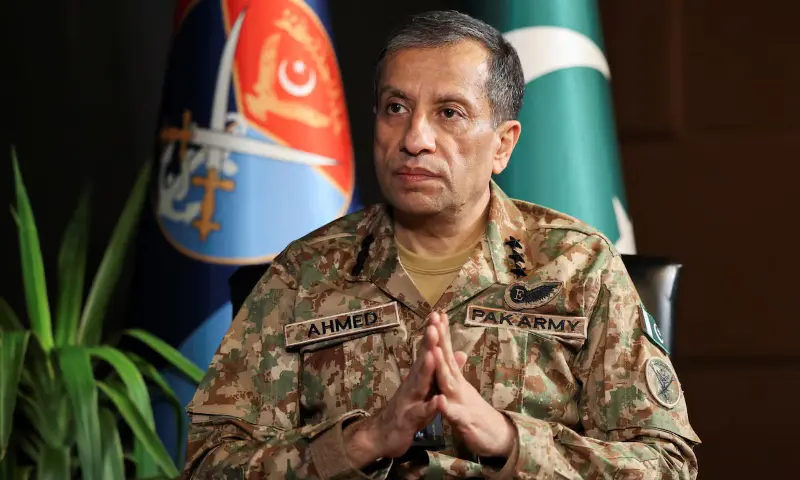
Inter-Services Public Relations (ISPR) Director General Lieutenant General Ahmed Sharif Chaudhry has affirmed that Pakistan is “much ahead” in operational readiness compared to the Afghan Taliban and India, adding that the country’s military is adopting emerging technologies. The military spokesperson’s remarks, shared by state media on Sunday, were made during Friday’s wide-ranging interview with an international outlet. The remarks aired today focused on the ongoing tensions between Islamabad and Kabul. Replying to a query about whether Islamabad was worried about the use of drones by the Afghan Taliban, considering their increased use in the ongoing Middle East conflicts, the DG ISPR said, “It’s a narrow thing that I’ll be worried about the drones being used by Afghanistan.” He noted that the Afghan Taliban had no military capabilities of their own, but those “provided by the sponsors”. He accused the Afghan Taliban of being a “proxy” of India, which he described as the “biggest terror sponsor”. Lt Gen Chaudhry then recalled that during the May 2025 conflict with India, Pakistan had shot down dozens of highly sophisticated drones sent from across the eastern border. “So those drones, wherever they were, turned them into dust everywhere. That was about two years ago. So we are much ahead where we stand in our own operational readiness,” he said, expressing confidence in Pakistan’s military capabilities compared to India as well. The DG ISPR said that the Pakistani army was adapting itself in a “very professional, well-thought-out way with the changing character of warfare”. “Whether it’s in non-contact [or] contact warfare, whether it’s in cyber, whether it is in drones, long-range missions, … we are very cognisant of what capabilities we need for the present and also for the future. “But you have rightly pointed out that this proliferation of this non-contact warfare means to the non-state actors like the Taliban, Khawarij, and Houthis; they pose a threat to everyone. And the states will have to reconsider and re-evaluate their security architecture,” he stressed. Asked whether Pakistan used artificial intelligence to help identify targets in Afghanistan, Lt Gen Chaudhry said he could not discuss the specifics of how the military used AI, quantum technology, cyber technology, and multiple other technologies, but that they can and should be used. “We are a technology-savvy army,” he asserted. Islamabad has repeatedly urged the Taliban administration in Kabul to dismantle terrorist sanctuaries on Afghan soil, particularly those linked to the banned Tehreek-i-Taliban (TTP), that are used for attacks in Pakistan. Officials say those appeals have gone unheeded. For their part, the Afghan Taliban have avoided taking a categorical position on the TTP and other groups, while dismissing Islamabad’s stance that Afghanistan is being used as a base for attacks against Pakistan. ‘Afghanistan has only two products: terrorism and drugs’ Asked about allegations by the Afghan Taliban of Pakistan’s involvement in coordinating anti-Taliban elements, Lt Gen Chaudhry rejected them. “That’s how you play the victim card.” The DG ISPR noted, “They are apt at using non-state actors, militias, mercenaries, for their objectives. So they think everyone does that. We are a state. Afghanistan is not a state. It is still being run by a non-state actor. It’s a regime.” He noted decades of foreign interventions, including by the erstwhile Soviet Union and the United States, following which multiple “agencies and proxies” established roots in Afghanistan. He said Afghanistan was perhaps the only country in the recent past that had been affected by interventions for 40 to 45 years. Lt Gen Chaudhry said: “The forces are gone physically, but still that front of Afghan Taliban is a proxy to multiple parties. In the case of Pakistan, the prime contractor is India. And the proxies are TTP and the BLA (Balochistan Liberation Army). “But there are others also,” he pointed out, naming East Turkestan Islamic Movement (ETIM), Islamic Movement of Uzbekistan (IMU), Jaish al-Adl, Al Qaeda, and Islamic State Khorasan Province (ISKP). “And this is not what I’m saying. [This] is what the United Nations reports and the intelligence assessments of the US and many other countries also say,” he stressed. “How could so many terrorist organisations, the whole alphabet, thrive over there?“ The DG ISPR further questioned, “Why would Reuters or anyone take the words of a non-state actor so seriously?” He said the Afghan Taliban could “come out with anything”, recalling false claims made by them of capturing a Pakistani pilot and presenting their own tanks as captured Pakistani tanks. Responding to a question about whether isolating the Afghan Taliban could further harm the neighbouring country, particularly its farmers affected by cuts in foreign aid, Lt Gen Chaudhry voiced Pakistan’s opposition to isolating Afghanistan. “I fu