'Water is our red line': Info minister says IWT cannot be unilaterally revoked or amended, remains in force
AI Summary
Pakistan's Information Minister reaffirmed the Indus Waters Treaty with India remains legally binding and cannot be unilaterally revoked. The treaty is critical for Pakistan's water security and agriculture, with international support backing Pakistan's stance amid ongoing tensions with India over water flows.
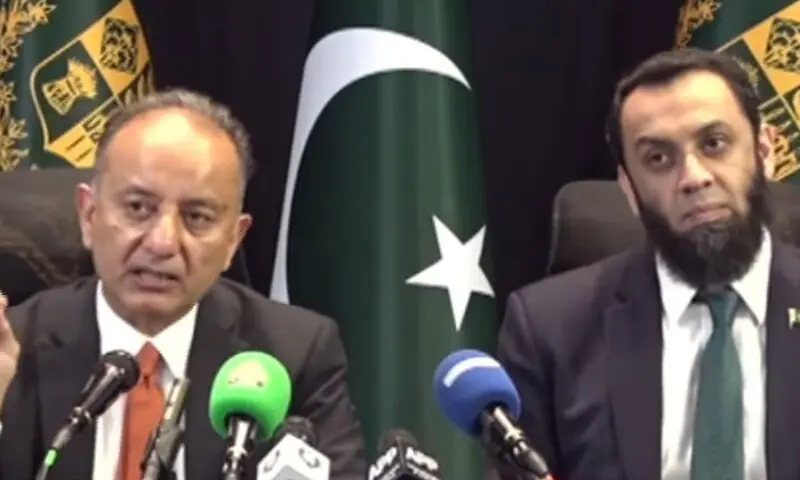
Information Minister Attaullah Tarar asserted on Monday that the Indus Waters Treaty (IWT) between India and Pakistan could not be unilaterally revoked or altered, stressing that the people of Pakistan had a right to Indus waterways under the “legally enforceable treaty” that remained in force. He said this while addressing a press conference alongside Climate Change Minister Musadik Malik in Islamabad. At the outset of the press briefing, Tarar said the world had endorsed that water security was important for Pakistan and the country had a right to it. “Legally, Pakistan’s stance has garnered support internationally, as the Indus Waters Treaty [between Pakistan and India] cannot be unilaterally revoked, abolished or amended,” he added. The minister said the Indus Waters Treaty (IWT) had laid out a framework with clarity, which was “in the field and [remains] implemented”. Tarar said Prime Minister Shehbaz Sharif and Chief of Defence Forces and Chief of Army Staff Field Marshal Asim Munir had stated multiple times that “water is our lifeline, as well as our red line”. “Our people have a right to water through a legally enforceable treaty that was accepted by both countries, that remains implemented today, and regarding which India has been disgraced on various forums. Their stance was not accepted at any forum,” he added. He said a seminar would be held in Islamabad on Tuesday, during which awareness would be raised about Pakistan’s rights under the IWT. “Water and legal experts from around the world will be attending the seminar,” he said. The minister reiterated that experts had accepted Pakistan’s rights under the IWT internationally. “So this is a victory of Pakistan in the narrative domain that the entire world is accepting its narrative and stance on the Indus Waters Treaty,” he said. Speaking after him, Malik said the matter of IWT had been raised at various international forums during the last month or two. “Pakistan’s stance was also endorsed at the international court of arbitration,” he added. Highlighting the consequences of irregular water flows, he acknowledged that it was partly due to climate change. But, he added, there was another factor as well. “There is a tap being controlled by the prime minister of our neighbouring country. He says he will not let even a drop of water flow into Pakistan,” Malik added. He said that this matter would be debated at the seminar tomorrow, noting that Pakistan’s 40 per cent to 50pc population relied on agriculture for their livelihood. Moreover, the country’s 20-25pc economy depended on agriculture. But, he continued, “someone else [is trying to] control all of the country’s food security, 50pc employment in the country and 25pc of the economy”. He added that Pakistan had already declared that anyone trying to deprive it of its water would face severe consequences. “And we have shown this as well,” he said. “But, there is also the question of justice. We will protect ourselves, […] but what about other countries and the poor elsewhere? Does every upper riparian now have the right to stop the flow of water to the lower riparian?” he questioned. He noted that elsewhere in the world, water kept flowing even without a treaty and only under a convention. “But we even have a treaty. […] How can the water be stopped here then? This is the case that we will present tomorrow,” he said. “The treaty exists,” he asserted, adding that Tuesday’s conference was primarily about justice and rights. “It will be decided what justice is internationally. […] It will be decided whether the children in lower riparians across the world have a right to water.” More to follow