Trump administration revives conspiracy theories about Cuba’s alleged manipulation of activism in the US
AI Summary
The US State Department released a report renewing Cold War-era conspiracy theories accusing Cuba of subversive activities in the US. These claims link Cuban communism to social unrest and civil rights protests but lack new evidence.
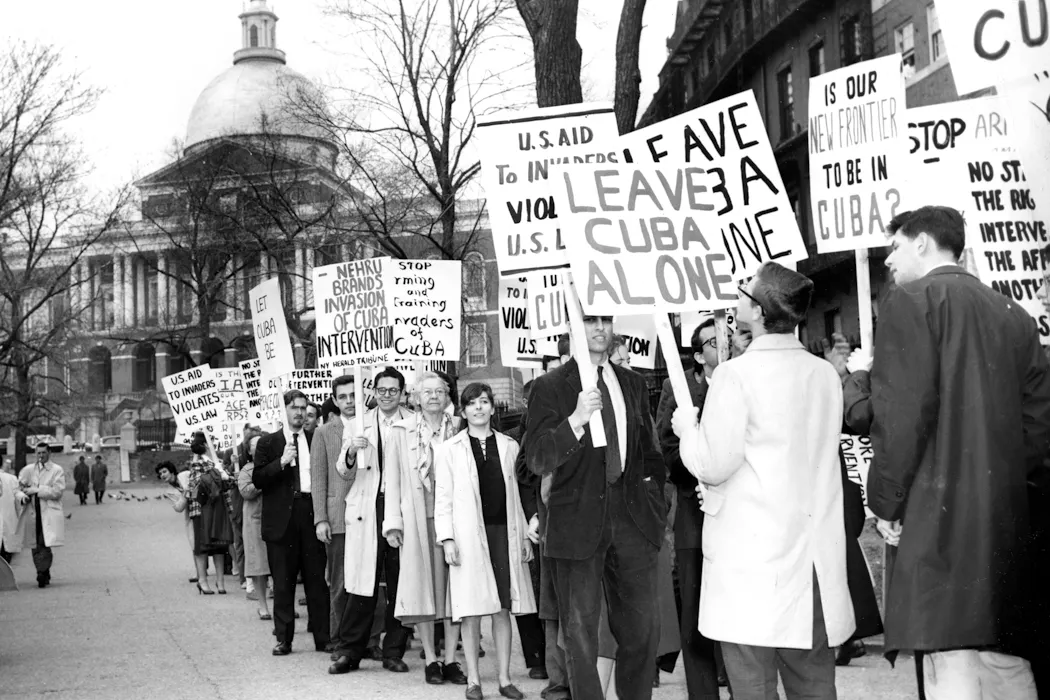
College students march on Boston Common to protest U.S. intervention in Cuba on April 22, 1961. Charles Dixon/The Boston Globe via Getty Images For nearly 70 years, Cuba has “waged a sustained campaign of subversion against the United States,” according to a newly released State Department report. “Cuba: The Capital of 21st Century Communism” sounds an alarm without offering any new insights into Cuban intelligence operations or explaining how the Caribbean island could be undermining its northern neighbor when its own economy is on the verge of collapse. Instead, the State Department re-ups an old conspiracy theory that partly blames Cuba’s communist leaders for contemporary U.S. social conflicts, such as the widespread protests held after the murder of George Floyd in 2020 and what it calls “the rise of Antifa.” Those movements “can be linked, in some way, shape, or form, to Cuban influence,” the State Department asserts. This report is new, but its claims are old. I have often come upon similar conspiracy theories about communist machinations in my research regarding U.S.-Latin American relations in the 20th century. Beginning in the 1960s, rumors spread that Cuban communists were engaged in the U.S. Civil Rights Movement. Those stories, like those the State Department is now telling, are false and peaked in the late 1960s. Cuban communist agents in Alabama? The 1959 Cuban Revolution did inspire many Americans to reassess their nation’s Cold War policies. Some people in the U.S. admired how Cubans overthrew dictator Fulgencio Batista, repelled the U.S.-backed 1961 Bay of Pigs invasion by Cuban exiles, and attacked neighboring dictatorships, such as those of the Dominican Republic’s Rafael Trujillo and Nicaragua’s Anastasio Somoza. Some appreciated how Cuba desegregated its beaches and hotels, although, to be sure, it does have a complicated legacy of racism that endures to this day. Many of the Americans who admired Cuba formed the Fair Play for Cuba Committee, a group that lobbied for normalizing U.S.-Cuban relations, in 1960. Immediately, conspiracy theories arose along these lines: Because many activists who supported Cuba’s communist government also supported civil rights in the U.S., therefore all civil rights activism was somehow shaped by Cuba. Along with airing accusations that Martin Luther King Jr. and other civil rights leaders were communists, the Manion Forum, an anticommunist media outlet, asked whether the “Communist Hand of Cuba” was “fingering Haiti, Venezuela, Panama, Birmingham?” The suggestion: Communists were directing civil rights protests in Alabama. The Manion Forum suggested that Cuban communism was responsible for civil rights protests in Alabama. John Raymond Pillion Papers, Cornell University The John Birch Society, an organization that also alleged that communists were behind the Civil Rights Movement, agreed. These claims were repeated throughout the 1960s by the Alabama Legislative Commission to Preserve the Peace, which regularly conflated all civil rights protests with communism. And the U.S. Senate’s Subcommittee on Internal Security echoed this narrative when it held hearings in 1960 and 1961 on what “Fair Play for Cuba” did. The State Department’s 2026 report on Cuba cites the subcommittee’s hearings as its only evidence that the Fair Play for Cuba Committee was subversive. Although more than 65 years have passed, the government has offered no new evidence. The Alabama Independent boosted the conspiracy theory that civil rights activists and Black Power militants were outgrowths of Cuban communism and the island’s ‘cultural offensive.’ Tom Anderson Papers, American Heritage Center, University of Wyoming Blaming Cuba for US activism These conspiratorial fears reached their zenith at the height of the Black Power movement, which emphasized racial pride and economic empowerment, when protests against the Vietnam War were widespread. Although few Americans have ever completely endorsed the Cuban regime, many U.S. leftists did admire Cuba’s educational and healthcare achievements, which contributed to their own ideas about how to address U.S. poverty. U.S. institutions of all kinds opposed to civil rights reforms spread conspiracy theories that communism, not domestic grievances, guided all these efforts to treat people of color more fairly. Lawmakers who opposed desegregation into the 1960s repeated the Senate Subcommittee on Internal Security’s reports that the Venceremos Brigade, a pro-revolution organization that helped Americans visit Cuba starting in 1969, was a “screen and tool of the Cuban intelligence apparatus.” This page from the State Department’s ‘Cuba: The Capital of 21st Century Communism’ that blames Cuba for leftist activism largely focuses on events that took place at least half a century ag