Torrential rains disrupt travel across GB as floods wash away roads, bridges
AI Summary
Torrential rains in Pakistan's Gilgit-Baltistan caused floods and landslides, washing away roads and bridges and disrupting travel. Thousands, including tourists, were stranded, and damages extended to infrastructure, agriculture, and utilities.
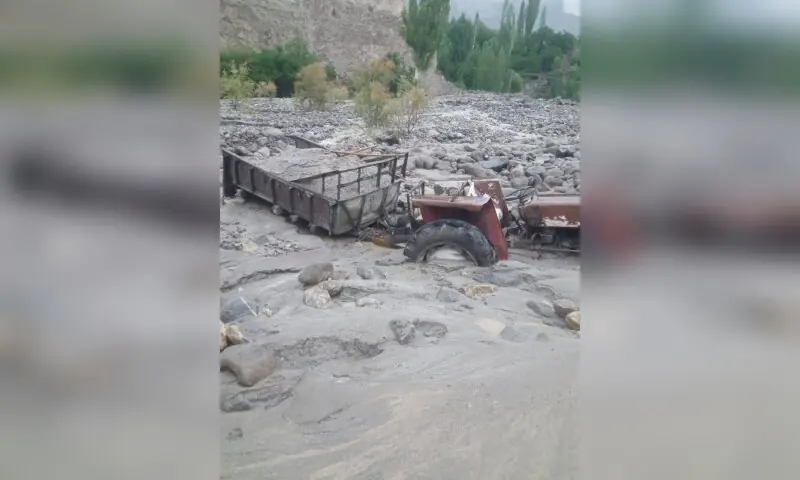
[Torrential rains](https://torrential rainfall) in Gilgit-Baltistan caused widespread travel disruptions in the mountainous region as flash floods and landslides washed away roads and bridges, leaving thousands, including tourists, stranded. The Pakistan Meteorological Department (PMD) forecast rain and warned of glacial lake outburst floods (GLOFs) in GB until July 26. Floods blocked the Karakoram Highway (KKH), Babusar Road, Baltistan Road, Naltar Highway, Ghizer-Shandur Road, Astore Valley Road and other routes connecting various remote areas, leaving thousands, including tourists, stranded at multiple locations. The GB Disaster Management Authority (GBDMA) said the KKH was blocked at multiple sections from Dassu to Hunza and Nagar districts. Picture taken on July 23, 2026 shows a tractor stranded after landslides and floods were caused by torrential rainfall in Gilgit-Baltistan. —Photo via author Continuous flooding at multiple locations caused difficulties for relief and rehabilitation activities. Many areas remained disconnected from surrounding regions as bridges and connecting roads were washed away. In Skardu, severe flooding in the Tormak Nallah area of Rondu subdivision washed away at least three important communication bridges, including the Malan Bridge. Floods also severely damaged roads, communication bridges, farmlands, crops and infrastructure in various areas of Kharmang, Ghanche and Shigar districts. Suspension bridges and power houses were also damaged by floods in Haramosh. Picture taken on July 23, 2026 shows aftereffects of landslides and floods caused by torrential rainfall in Gilgit-Baltistan. —Photo via author Electricity and water supply systems were disrupted, suspending communication services in Astore, Tangir, Thore and other areas of Diamer. Furthermore, drinking water schemes, irrigation channels and protective embankments were destroyed, while several villages were cut off from one another. Dozens of families in Losala village of Astore, Thore Valley, Tangir in Diamer and other areas were rendered homeless as a result of floods and landslides. Picture taken on July 23, 2026 shows a van stuck after landslides and floods were caused by torrential rainfall in Gilgit-Baltistan. —Photo via author Across Ghizer district, temporary road blockages, localised flooding and partial damage to two houses were reported. As a precautionary measure, vulnerable communities were evacuated to designated safe locations. Rising water levels in the Hunza-Nagar River have placed eight households in Gilgit’s Jutal area at risk. Picture taken on July 23, 2026 shows aftereffects of landslides and floods caused by torrential rainfall in Gilgit-Baltistan. —Photo via author In Ghizer, river erosion has damaged agricultural land and non-fruit trees in Yasin Valley, Sheliabad, Amit and other areas, while the Ghizer-Shandur and Ghizer-Gilgit roads remain blocked. Authorities have advised passengers and tourists to avoid unnecessary travel in the region. Authorities’ response A statement issued by the GBDMA said rising water levels in rivers and streams had damaged homes, roads, bridges, crops and agricultural land. The GBDMA, district administration, Rescue 1122 and other agencies are jointly engaged in relief activities, according to the statement. As of Thursday, affected families were being shifted to safer locations, while the process of providing tents, rations, medicines and clean drinking water was underway. The GBDMA said relief items, including tents, food, medicines and other essential supplies, had been provided to affected people. Picture taken on July 23, 2026 shows aftereffects of landslides and floods caused by torrential rainfall in Gilgit-Baltistan. —Photo via author GB Chief Minister Amjad Hussain directed authorities to expedite relief and rehabilitation work in the affected areas. CM Hussain instructed all concerned departments and the district administration to remain on alert round the clock to ensure the safety of lives and property. He directed the food and health departments to ensure an uninterrupted supply of rations, clean drinking water, tents, medicines and other essential items in the affected areas. Orders were issued to immediately mobilise heavy machinery for emergency repairs of infrastructure, bridges and main and secondary roads damaged by flash floods, and for the restoration of traffic. The GBDMA and district administration were directed to remain proactive in dealing with the emergency situation by maintaining close coordination with the NDMA. The CM said that the provincial government would not leave the people alone in this difficult time. “Rehabilitation of the victims and all possible assistance will be ensured by utilising all available resources,” he added. He directed all concerned commissioners and deputy commissioners to conduct field inspections themselves and submit daily monitoring