The Black Box Problem in Cognitive Warfare: Why “Targeting Cognition” Is Not Enough
AI Summary
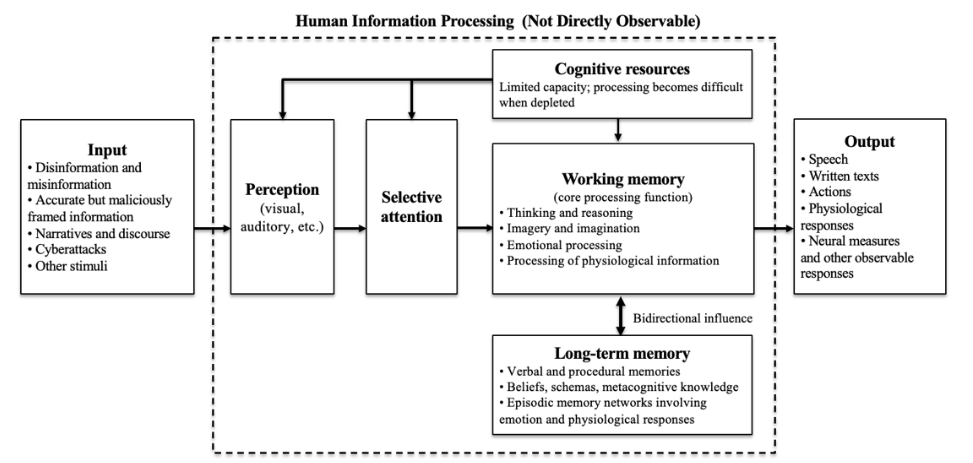
This essay examines cognitive warfare, critiquing the notion that targeting cognition alone suffices. It discusses the complex interactions between informational inputs and behavioral or attitudinal outputs, highlighting the need to consider the cognitive middle layer including perception, memory, and decision-making processes.
Abstract Cognitive warfare is often presented as a distinct form of conflict because it targets cognition, the brain, or decision-making itself, but that claim becomes weaker when the analyst can observe only the relationship between informational inputs and behavioral, attitudinal, or organizational outputs. This essay argues that the cognitive middle layer, including attention, perception, memory, emotion, belief, reasoning, and decision-making, … Read more The post The Black Box Problem in Cognitive Warfare: Why “Targeting Cognition” Is Not Enough appeared first on Small Wars Journal by Arizona State University.