Text of the Makkah defence agreement
AI Summary
The published text of a trilateral defence agreement between Türkiye, Pakistan, and Saudi Arabia sets out commitments to mutual assistance in response to external armed attacks. It also provides for cooperation on defence, security, counterterrorism, military training, and consultations, and has been submitted for parliamentary approval.
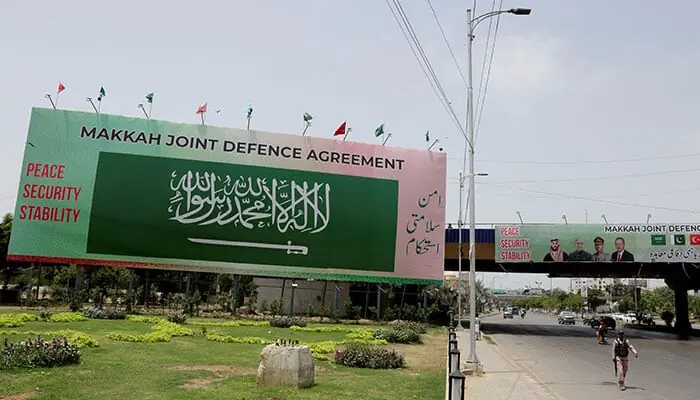
FOLLOWING its submission for parliamentary approval, Turkish state broadcaster TRT Haber and other outlets have published the text of the Makkah Joint Defence agreement. The 16 articles of the trilateral defence agreement are reproduced here. The Government of the Republic of Turkiye, the Government of the Islamic Republic of Pakistan, and the Government of the Kingdom of Saudi Arabia (hereinafter referred to as a “party”, the “parties”, or the “core parties”). Article 1: The “parties” shall cooperate to ensure and safeguard one another’s independence, sovereignty, territorial integrity, and the inviolability of their internationally recognised borders. If the territorial integrity, sovereignty, or internationally recognised borders of any of the “parties” are threatened or endangered, the “parties” shall use all necessary means to eliminate such threat(s) or danger(s). Article 2: An externally originating armed attack against any of the “parties” shall be considered an attack against all the “parties.” If one of the “parties” is subjected to an armed attack or military aggression by another country or group of countries, the “parties” shall immediately assist the attacked “party,” making full use of all means of mutual assistance that they can provide to one another. For this purpose, to enable the exercise of the right of self-defence recognised by Article 51 of the Charter of the United Nations, the “parties” shall determine the scope and nature of the support to be provided following an objective assessment of the assistance required, and shall cooperate within the limits of their available resources, including military means and capabilities. Article 3: Pursuant to Article 2 of this agreement, the “parties” shall cooperate closely in the fields of defence, defence industry, and security; develop relations among their Armed Forces; and carry out agreed activities aimed at strengthening cooperation in defence. Article 4: The “parties” shall hold regular consultations on international security matters. They shall continuously and effectively assist one another and cooperate in developing individual and joint measures based on common assessments, in order to protect their vital interests and national security and eliminate threats and dangers to their national security. Article 5: The “parties” shall strengthen existing cooperation and joint efforts, including at the operational level, in combating terrorism in all its forms and manifestations that adversely affect regional and international stability and security. Article 6: In wartime and peacetime, the “parties” shall encourage reciprocal personnel exchanges among defence institutions, joint training programmes and exercises, and deployments and activities aimed at increasing the interoperability of the “parties’” armed forces, in order to develop their defence capabilities. Article 7: To strengthen their defence capabilities, the “parties” shall, on the basis of mutual agreement, support technology sharing among defence-industry institutions, joint technology development, joint production, and cooperation among defence-industry organisations in the following areas: a) Encouraging joint production in the field of defence; b) Implementing defence innovation through joint research and development projects in technologies requiring specialised expertise; c) Training personnel and supporting the military industry within the territories of the “parties” through experts from any “party”; d) Sharing expertise and lessons learned in the fields of defence industry, defence research and development, and innovation; e) Other areas of cooperation mutually agreed upon by the “parties”. Article 8: The “core parties” shall establish a “Strategic Political and Defence Committee”, comprising the Foreign Ministers, Defence Ministers, and Chiefs of General Staff of the “parties” to provide strategic direction for joint defence, develop defence and security cooperation among the “parties” and address obstacles that may arise during the implementation of this agreement. The Committee shall meet twice a year, with hosting rotating among the “parties”. The leaders of the “parties” may meet once a year if deemed necessary. The “Strategic Political and Defence Committee” may establish subcommittees if it considers this necessary. Agreements or protocols shall, where necessary, be negotiated among the “parties” for the implementation of the areas of cooperation envisaged in this agreement. The “Strategic Political and Defence Committee” shall be authorised, by consensus of the “core parties”, to determine and approve the procedures and principles governing the accession of other “parties” to this agreement. A Secretariat headquartered in the Kingdom of Saudi Arabia shall be established to serve the “Strategic Political and Defence Committee”. The Secretariat shall conclude a headquarters agreement with the Kingdom of Saudi Arabia. The procedures and principle