POLICY: GEOPOLITICAL TETRIS
AI Summary
The opinion piece compares today’s interconnected geopolitical crises to a crowded game of Tetris, arguing that states—especially Pakistan—have less room to maneuver as conflicts and strategic rivalries compound. It surveys the effects of Russia’s war in Ukraine, tensions involving Iran, Israel and the United States, European security and energy pressures, and China’s cautious posture on global trade and investment.
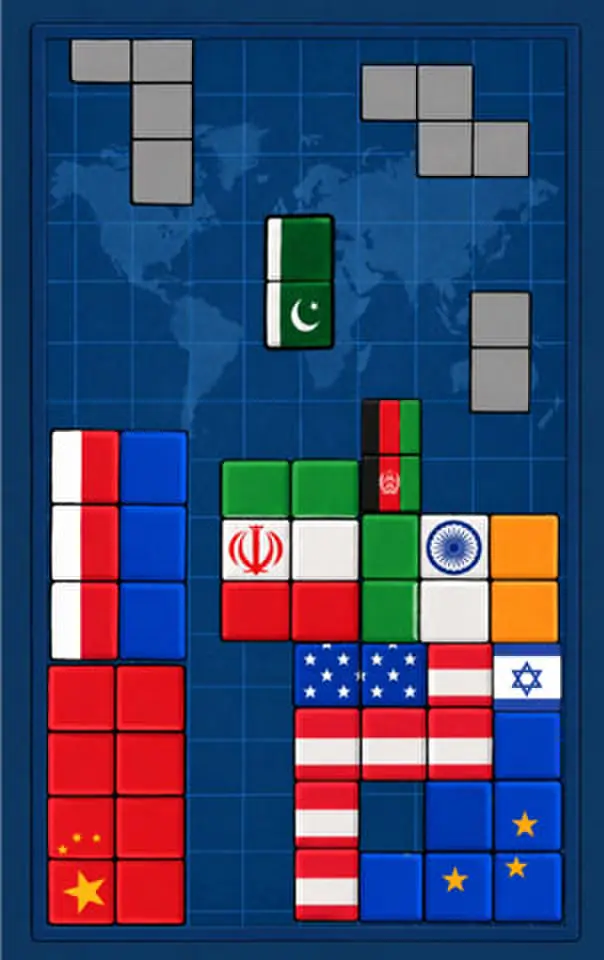
Illustration by Sarah Durrani Tetris is an interestingly simple but challenging game. Blocks of different shapes descend on to a confined board and the player must continuously find space to accommodate them. Every placement affects the next move. As the board fills, choices diminish, mistakes become increasingly expensive, and even the right piece arriving at the wrong time can become a problem. The evolving global geopolitical landscape bears an astonishing resemblance to this game. Yet the intrinsic simplicity of the game is missing: the blocks are getting larger, time and space are shrinking, and states have less freedom to position themselves without new vulnerabilities. A bird’s eye view of the prevailing environment reveals that Russia remains locked in Ukraine in a contest it portrays in terms of security, strategic identity and its place in the European order. Europe, meanwhile, is grappling with the perceived long-term threat from Russia, the burden of sustaining Ukraine, changing ties with Washington, the demands for greater burden-sharing, energy insecurity and sluggish growth. Long-standing assumptions underpinning European security no longer appear immutable. In the Middle East, the widening confrontation involving Iran, Israel and the United States has transformed an already unstable region, where escalation can have consequences far beyond its geographical boundaries. A prolonged crisis in the Gulf can rapidly translate into higher energy costs, inflation, disrupted supply chains and slower growth in South and Southeast Asia. As global power shifts, the world gets reconfigured and crises become increasingly interconnected, Pakistan must decide which relationships to prioritise — and which commitments it can no longer afford Amid this deafening strategic noise, China has displayed what may be described as strategic restraint. Beijing has enormous economic stakes in the stability of the Middle East and the international trading system, yet it prefers to remain cautious of direct entanglement in these conflicts. Whether this represents deliberate patience or a preference to let others exhaust themselves is debatable. China’s willingness to help shape the emerging order remains uncertain. Such is perhaps the defining characteristic of today’s geopolitical Tetris: the pieces are no longer independent of one another. A conflict in Ukraine alters Europe’s security and energy calculations. War in the Middle East affects Asian economies. Competition between Washington and Beijing influences technology, trade, investment and supply chains across continents. Global interdependence has erased the geographical separation between crises. The question, therefore, is not how individual crises will end, but what international system will emerge as the pieces settle. THREE WAYS TO READ THE BOARD Let us see how various schools of thought view the changing global landscape. Offensive realism holds that great powers operating in an uncertain international system seek power, favourable balances and regional predominance, because they cannot entrust their survival to the intentions of others. Viewed through this prism, the present turbulence may represent less an aberration than a redistribution of global power. Such an order may contain several poles yet revolve predominantly around two centres of gravity: the US and China. Russia, India, Europe and other consequential powers will occupy important spaces, but much of international politics could increasingly be influenced by competition between Washington and Beijing. At its extreme, this could produce informal spheres of influence, accompanied by expectations of non-interference in each other’s core strategic spaces. Another view sees the turbulence of [US President Donald] Trump 2.0 as a disruption rather than the definitive end of the US-led international order. Institutions, alliances, financial networks and economic relationships built over eight decades possess considerable resilience. A post-Trump US could return to its traditional alliances and restore much of the tone and tenor of the previous order, albeit under changed circumstances. A third viewpoint holds that the emerging system may be neither conventionally bipolar nor genuinely multipolar. It could become an untidy combination of both, with several centres of power operating beneath an overarching US-China rivalry. A country may depend upon China for infrastructure, the US for technology and finance, the Gulf for energy, Europe for exports and another state for security cooperation. Geopolitical blocs increasingly overlap. This is almost the projection of the existing fragmented order in a more orderly manner. WHERE PAKISTAN FITS For Pakistan, this geopolitical Tetris raises several practical questions. Should Pakistan lean towards China or rebalance towards the US? Should it privilege its Gulf relationships or accommodate Iran? Should regional connectivity or traditional security considerati