Pakistan hits back at India's attempt to 'distort facts', says holding IWT in abeyance 'simply illegal'
AI Summary
Pakistan strongly rejects India's unilateral decision to hold the Indus Water Treaty in abeyance, calling it illegal and a breach of international norms during a United Nations Security Council debate. Both countries accused each other of state-sponsored terrorism and violations related to Kashmir, escalating regional political and security tensions.
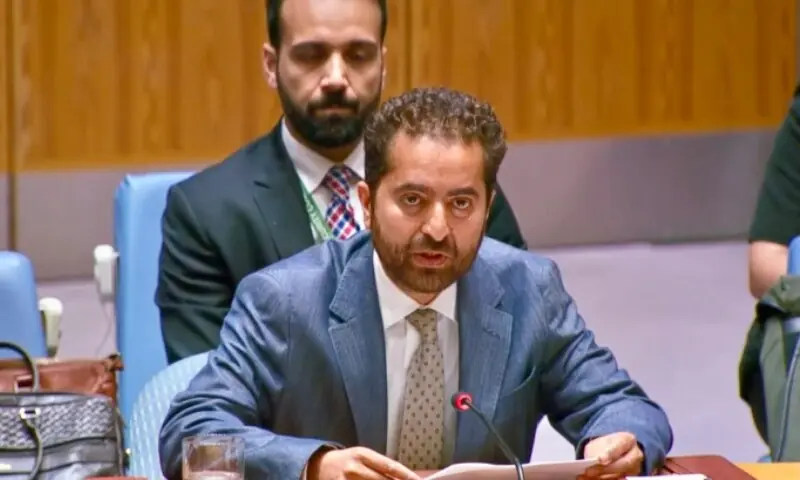
Pakistan on Thursday rejected India’s attempt to “distort facts” about the Indus Water Treaty (IWT) at a United Nations Security Council (UNSC) open debate, saying that New Delhi’s actions in the aftermath of the attack in occupied Kashmir’s Pulwama were “simply illegal”. At a UNSC debate on natural resource governance, Pakistan’s Permanent Representation to the UN Asim Iftikhar Ahmad had highlighted India’s unilateral decision to hold the treaty in abeyance, saying that “no state should be permitted to abuse shared water resources as an instrument of coercion or political pressure, much less when it breaches solemn treaty obligations”. Subsequently, India’s Permanent Representative to the UN Ambassador Harish Parvathaneni had accused Pakistan of “state-sponsored cross-border terrorism”, saying that it had “eroded the basis for bilateral cooperation on the treaty”, according to Indian news agency ANI. He had also asserted New Delhi’s claim on occupied Kashmir. In response, Pakistan’s First Secretary Ansar Shah responded, saying India’s “misleading statement” was a “futile attempt to distort facts and misrepresent the situation”. “The treaty contains no provision whatsoever permitting its so-called abeyance. India’s unilateral action is simply illegal,” he said. Shah said that the Permanent Court of Arbitration (PCA) in August 2025 had reaffirmed that the treaty “remains valid, binding and fully in force, together with its dispute settlement mechanisms”. “India’s weaponisation of a shared natural resource for political coercion, with the stated aim of starving the population of Pakistan, is a serious breach of legal instruments and international norms,” Shah highlighted, adding the situation poses a “direct threat to regional and international peace and security and is completely germane to today’s debate”. The first secretary also dismissed India’s “baseless assertion regarding terrorism”, saying it was an effort by New Delhi “to conceal its sponsorship and financing of terrorism against Pakistan”. “India’s terrorist proxies — the Tehreek-i-Taliban Pakistan, Balochistan Liberation Army and Majeed Brigade — have killed thousands of civilians and law enforcement personnel, including women and children on our soil,” Shah said. “India’s involvement in extraterritorial executions including in North America is also well known. India is not a victim of terrorism. It is a sponsor of terrorism,” he said. He went on to say that India was also a perpetrator of state terrorism in the Occupied Kashmir. He added that the population of the territory “is being denied its right to self determination in gross violation of numerous resolutions of the UNSC”. “India continues to disregard its obligations under the UN Charter, including Article 25, which requires member states to carry out the decisions of the Security Council,” he said, adding that occupied Kashmir “never was, nor is, an integral part of India”. “No unilateral or unlawful measures by the occupying power can alter the historical, legal and disputed character of the occupied territory of Jammu and Kashmir,” he added. ‘Natural resource governance must be anchored in international law’ In his remarks, Ambassador Ahmad had said that natural resources should serve as instruments of sustainable development and prosperity and must not become sources of conflict, coercion or exploitation. “Yet, in many contexts, weak governance, illicit extraction, external interference, violations of international law and UN Charter, and the unequal distribution of benefits continue to fuel instability and conflict, and exacerbate humanitarian crises,” he said. He pointed to Africa, saying that Pakistan had long stood in solidarity with African countries in their pursuit of sovereign control over their natural wealth. “Sustainable peace cannot be achieved where immense natural wealth coexists with persistent poverty and underdevelopment. It is a recipe for conflict,” he asserted, adding that natural resource governance must remain firmly anchored in the UN Charter and international law. “The right of peoples to permanent sovereignty over their natural wealth and resources, as enshrined in General Assembly resolution 1803, remains fundamental. International cooperation must strengthen national capacities while respecting national ownership, priorities and policy space,” he said. Highlighting India’s decision to hold the IWT in abeyance, he said, “Our eastern neighbour has sought to weaponize water against Pakistan by abusing its status as the upper riparian, unilaterally and illegally placing the Indus Waters Treaty in abeyance – a course of action for which neither the Treaty, nor the general principles of international law, provide any basis whatsoever. Pakistan categorically rejects this unlawful action, which directly threatens the livelihoods and well-being of more than 240 million people of Pakistan.” He said that the IWT remai