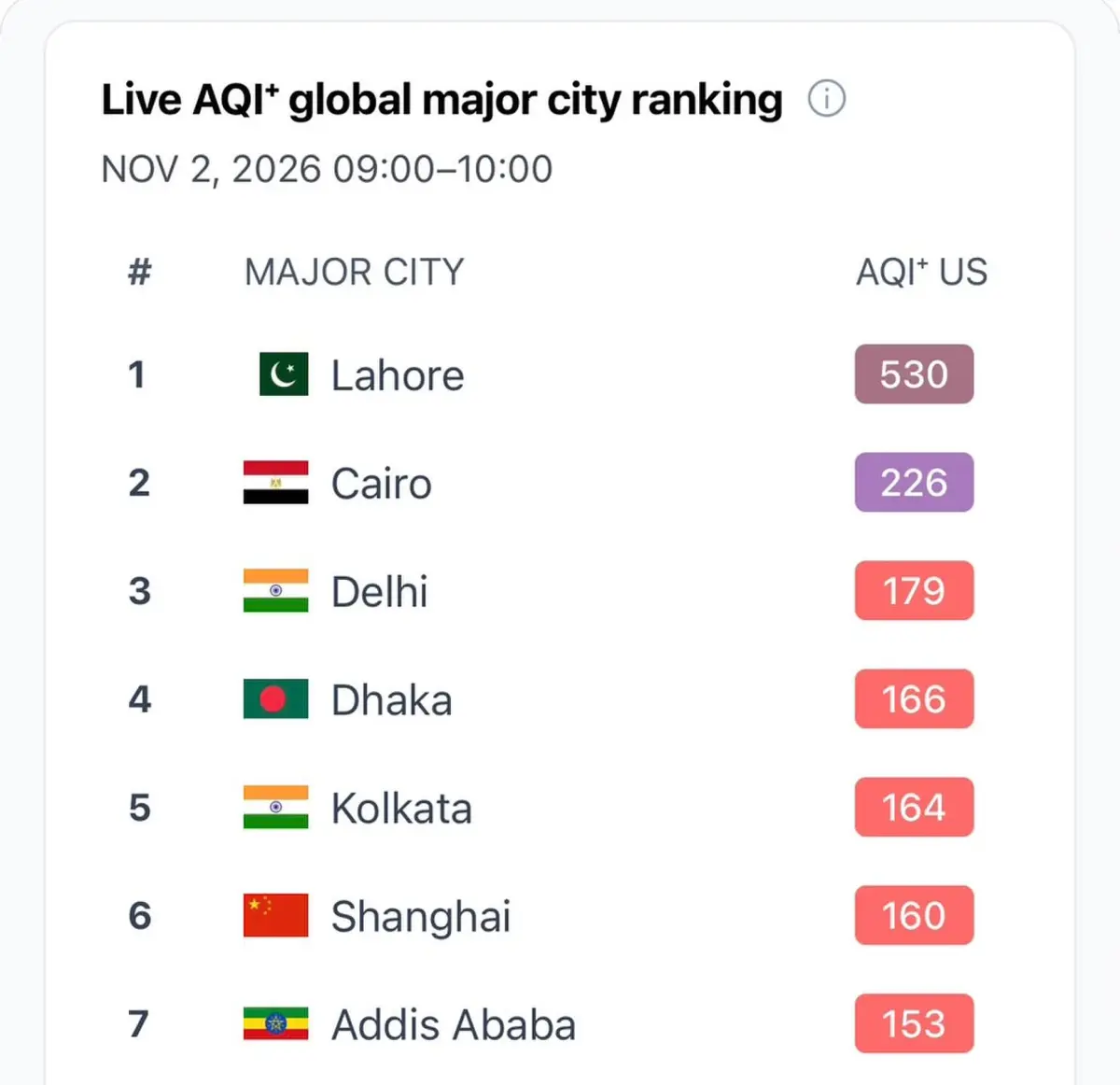
Lahore's air quality index crosses 530 as pollution reaches hazardous levels
AI Summary
Lahore and several other Punjab cities recorded hazardous air pollution, with Lahore’s AQI reaching 535 and PM2.5 measuring 343 micrograms per cubic metre. The report links the worsening conditions partly to extensive crop-residue burning, alongside vehicle and industrial emissions and weather that traps pollutants near the ground.
LAHORE: Air pollution in Lahore reached hazardous levels on Monday, with the Air Quality Index (AQI) crossing 530 and fine particulate matter (PM2.5) concentrations climbing to 343 micrograms per cubic metre. Several other cities in Punjab also recorded extremely high pollution levels, according to air quality monitoring platform IQAir. At 8am, IQAir recorded an AQI of 535 in Lahore, placing the city in the hazardous category. PM2.5 concentration, referring to tiny particles that can penetrate deep into the lungs and enter the bloodstream, stood at 343µg/m³. Air quality had already deteriorated sharply in the early morning, with hourly readings also entering the hazardous range. Figure shows the top ranked polluted cities according to IQAir on Friday morning. — Screengrab via IQAir The deterioration was not confined to the provincial capital. IQAir’s live ranking of Pakistani cities on Monday morning placed five Punjab cities among the country’s six most polluted urban centres. Gujranwala topped the ranking with an AQI of 606, followed by Lahore at 509, Faisalabad and Multan at 310 each, and Sialkot at 260. Peshawar ranked sixth with an AQI of 216. The readings varied across monitoring updates, with Gujranwala subsequently recording 675 and Lahore 535 in separate hourly updates, highlighting the rapidly changing pollution situation. Figure shows the top ranked polluted cities in Pakistan according to IQAir on Friday morning. — Screengrab via IQAir The worsening air quality comes amid a sharp increase in agricultural fire detections across Punjab. According to an analysis published by environmental monitoring website HamariHawa, Nasa satellites detected 13,241 fire spots in Pakistani Punjab between Oct 1 and 29, compared with 3,158 in Indian Punjab — 4.2 times as many. Around 92 per cent of the detected fires in Pakistani Punjab were located on farmland and were likely associated with crop-residue burning. The analysis found that 6,655 fire spots, around half of the monthly total, were detected during the last seven days of October. Oct 29 recorded the highest number of detections, at 1,327. Okara recorded the highest number of fire spots at 2,144, followed by Gujranwala with 1,011 and Nankana Sahib with 1,003. The findings point to extensive agricultural burning in the rice-growing belt surrounding Lahore. Smoke from these fires, along with emissions from vehicles, industries and other sources, adds to the regional pollution burden. Weather conditions, including weak winds and atmospheric inversions, can further trap pollutants close to the ground. Weather factor Meanwhile, a new analysis by the Pakistan Air Quality Initiative (PAQI) has questioned the extent of improvement in Lahore’s air quality during October, despite government claims that the city experienced its cleanest October in five years. According to PAQI, average PM2.5 concentrations in October 2026 fell by 27 per cent compared with the same month last year across 26 monitoring sites. However, after accounting for weather conditions, the improvement was estimated at just four per cent. The analysis attributed a substantial part of the decline to weather conditions, particularly a deeper nighttime atmospheric mixing layer, which allowed pollutants more room to disperse. The remaining improvement reflected the combined effects of government measures, changes in agricultural burning and other pollution sources. However, the analysis could not establish the individual contribution of each factor. Despite the decline, PM2.5 concentrations exceeded Pakistan’s prescribed daily limit on every day in October, according to PAQI. The initiative’s forecast, issued on Nov 1, projected PM2.5 concentrations to rise to 149µg/m³ by Wednesday, Nov 4 — around 49pc above October’s average. The findings offer a more cautious assessment of the improvement claimed by the provincial government. Punjab Senior Minister Marriyum Aurangzeb had shared data with Dawn in October showing that Lahore’s average US AQI (PM2.5) stood at 180.5 during October 2026, compared with 204.6 in 2025, 213 in 2024 and approximately 193 to 195 in 2022 and 2023. Her data showed that October 2026 was the only year among the five in which the city did not record an AQI above 300, with the highest reading standing at 262 on Oct 31. However, PAQI’s assessment underlines that the improvement was partly weather-driven and that pollution remained above the national health standard throughout the month. With November bringing a fresh deterioration in air quality, the latest readings and satellite fire detections highlight the continuing challenge of controlling agricultural burning and other sources of pollution across Punjab.