India loses information war to country that wasn't technically allowed online
AI Summary
The article discusses the ongoing information warfare between India and Pakistan, highlighting how social media plays a crucial role in shaping public perception during conflicts. It illustrates India's initial advantages in disinformation tactics but notes that Pakistan's netizens managed to turn the narrative in their favor during the latest conflict, marked by missile strikes and contested claims.
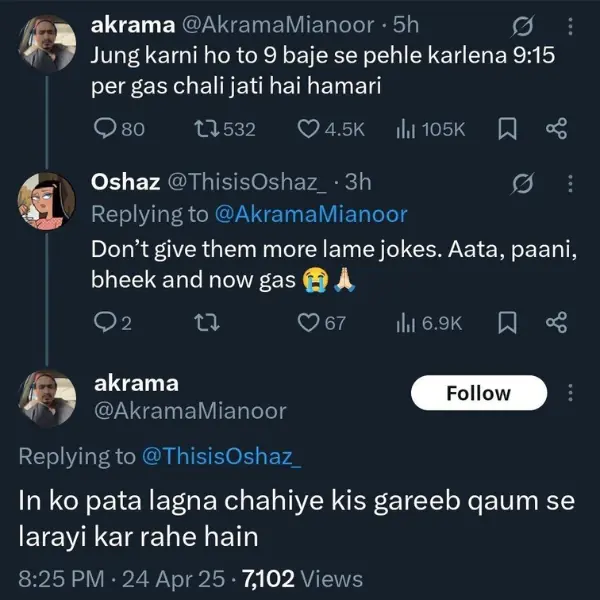
“In information warfare, perception is the battlefield. If the news damages the other side—true or false—amplify it. Post it. Share it. Make it viral. Let panic spread across the border. If the news harms us — even if true — bury it. Suppress it. Disarm it before it spreads. This is not journalism. This is war. Every post is a bullet. Never fire one at your own country.” — Anonymous X user, Indo-Pak conflict, May 2025 “Jung karni ho to 9 baje se pehle kerlena — 9:15 per gas chali jati hai humari.” (If you want to finish a war, do it before 9 PM — our gas goes off at 9:15.) — Pakistani X user, also during the conflict, May 2025 When Indian missiles struck multiple targets inside Pakistan on May 7, 2025, two wars began simultaneously. One war involved aircraft, coordinates, and competing casualty figures that neither side would ever fully agree on. The other war was fought on X, Instagram and WhatsApp, in Urdu, Hindi, English and meme formats that require no language at all. The first war ended in four days of contested claims and a ceasefire both sides described as a victory. The second war had a clearer and a far more unexpected result. Our netizens turned the odds in their favour. They not only fought but actually won the narrative battle. It is the question of how it did this that illuminates the direction of information warfare, and who, unexpectedly, is leading it there. A murder of crows It shouldn’t have been this outcome. India entered the information war with every structural advantage. Multi-decade disinformation influence operations documented by international watchdogs produced one of the most organised online nationalist ecosystems on the planet. India was coordinated, enormous, and primed for exactly this kind of conflict. While we might take pride in our fifth-gen warriors or 5Gs, Pakistan entered the infowars with a year-long ban on the platform where most of the battle would be fought, in a country where blackouts (electricity, internet, press freedom) are a condition of daily life rather than a wartime imposition. And yet, we prevailed. We saw a preview in Balakot, circa 2019, in a brazen act of diplomatic trolling. India’s Mirage jets crossed into Pakistan and, by India’s telling, killed hundreds of militants in a precision counter-terrorism strike. According to Pakistan’s version and that of Reuters reporters who visited the site, India actually killed four trees and some crows. India held a press conference. Pakistan filed an FIR against unnamed IAF pilots for environmental destruction, submitted a formal dossier to the United Nations demanding India be declared an “eco-terrorist,” and moved to strip Modi of the “Champion of the Earth” award the UN had given him. A song was composed in memory of the fallen trees. An annual holiday (Fantastic Tea Day) was established to honour Wing Commander Abhinandan Varthaman, who had been served chai in Pakistani captivity and had called it “fantastic”. Pakistan did not contest India’s narrative. It replaced it with one so specific, so absurd, and so verifiably grounded that India’s victory claims curdled on contact. This is Malcolm Gladwell’s David and Goliath at work. The giant loses not because David is stronger, but because David refuses to play the giant’s game. India wanted a narrative war conducted on the terms of the powerful—solemn, institutional, credential-heavy. Pakistan showed up with an eco-terrorism complaint and a tea holiday. The giant never recovered its footing. Beaten to the punchline Coming back to 2025, India’s information manual against Pakistan was, and usually has been, straightforward (some might even say boring): you are poor, you beg from the IMF, your infrastructure is a humanitarian emergency, you commit rights violations, you’re a terrorist state, your country doesn’t have resources, etc. These are real vulnerabilities which are documented, painful, and definitely not invented. As weapons of narrative warfare, they should have been devastating. And yet, they were not. Because Pakistan fired them first. At itself. And laughed. When a Pakistani user posted “Jung karni ho to 9 baje se pehle kerlena—9:15 per gas chali jati hai humari,” they weren’t being self-pitying. (If you want to go to war, do it before 9pm, our gas load shedding starts at 9:15pm). They were challenging the Indians to do their worst…what can they do that we haven’t done to ourselves already? — screengrab from X Owning a weakness so completely, so publicly, so cheerfully, neutralised any attempts at damage. You cannot humiliate a country that is already laughing harder than you are. And you certainly cannot humiliate one that has beaten you to the punchline. What is more, we didn’t need a coordinated effort to achieve this, just a shared sense of deprecation. Linguist Steven Pinker, in When Everyone Knows That Everyone Knows, calls this common knowledge. It is the public, visible consensus that coordinates collective posture without is