Going green with solar
AI Summary
Pakistan is witnessing a rapid shift towards solar energy, fueled by soaring electricity costs and falling solar panel prices, supporting the country's climate commitments. This consumer-driven energy revolution may reshape the country’s energy landscape significantly.
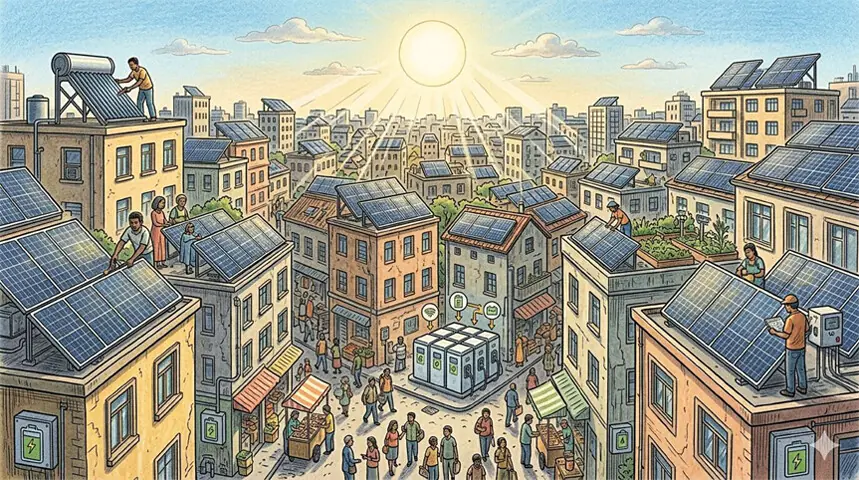
PAKISTAN is undergoing an energy revolution unlike any the country’s planners designed, any donor funded, or any government blueprint envisioned. Rooftop by rooftop, tubewell by tubewell, factory floor by factory floor, ordinary Pakistanis are building one of the fastest clean energy transitions ever recorded. In a country simultaneously battered by catastrophic floods, record-breaking heatwaves and an electricity tariff crisis of its own making, the sun has become both an escape route and, quietly, a contributor to Pakistan’s climate commitments. This is the story of that revolution, and the storm gathering in its wake. The roots of Pakistan’s solar revolution lie in a catastrophic confluence of policy failure, global market forces and consumer desperation. Between 2021 and 2024, electricity tariffs surged by 155 per cent, driven by IMF-mandated removal of subsidies, soaring fuel costs from the Russia-Ukraine war, and capacity payments owed to idle CPEC-era thermal plants. At the peak, electricity bills in some households exceeded monthly house rent in major cities. Simultaneously, Chinese solar manufacturers faced massive overproduction. Panel prices fell from 32 cents per watt in early 2024 to 17 cents by yearend, and further to USD 0.08 per watt by 2025. This ‘perfect storm’, soaring grid costs meeting collapsing panel prices, ignited an unprecedented consumer response. In FY 2024-25, Pakistan imported 18GW of solar panels, according to Ember and Renewables First, building on 16.6GW in 2024. Cumulative imports reached 51.5GW by November 2025, making Pakistan the third-largest destination for Chinese solar exports. Solar’s share of utility electricity tripled from four per cent in 2021 to 14pc in 2024, reaching 25.3pc by early 2025, placing Pakistan among fewer than 20 countries to achieve that milestone. The consumer-led revolution has been remarkable, but it has also brought in its wake a storm that the government needs to address rather urgently and effectively, believes Ali Ahsan Urban high-consumption households were the earliest adopters. Pakistan’s volumetric pricing structure penalises heavy usage, as tariffs rose, those with capital went solar first. Payback periods compressed to one to two years, and a 2015 net metering policy enabled sale of surplus power to the grid. By December 2024, there were 283,000 net-metered consumers. However, official figures capture only a fraction, with Renewables First and TransitionZero estimating that between 27GW and 33GW have actually been deployed, mostly off-grid. In rural Pakistan, approximately 80pc of the country’s 1.5-2 million tubewells historically ran on imported diesel. As subsidies were removed, solar pumps became dramatically more economical. Agricultural electricity demand on the national grid fell 34.3pc in 2024. The World Resources Institute estimates that half of all tubewells would ultimately convert to solar, adding 5.6-7.5GW of distributed photovoltaic (PV) capacity. The textile sector, consuming nearly one-third of Pakistan’s industrial electricity, has embraced solar to cut costs and meet global sustainability standards. The European Union’s Carbon Border Adjustment Mechanism (CBAM) has added urgency for export-facing manufacturers. Industrial firms have each installed multi-megawatt systems. Industrial grid demand fell from 31,008GWh in FY2023 to 27,830GWh in FY2024, a clear signal of structural defection. Regulatory turbulence The Pakistani state has begun to respond, not always constructively. Under the original net-metering policy, solar consumers enjoyed a real benefit of approximately Rs40-50 per kWh; proposed changes slash this to Rs8-10, an almost 80 per cent reduction. The government’s Economic Coordination Committee has signalled a move to a net billing framework, significantly undermining residential solar investment. Hasnat Khan, Senior Vice-Chairman of the Pakistan Solar Association (PSA), is unambiguous in his assessment. “People have invested their hard-earned money to install solar systems and many have even taken loans,” he said in a media interaction”, adding that the new rules “will make it difficult for people to recover their investment” and stressing: This is green energy and it should be encouraged.” Waqas Moosa, the PSA Chairman, warns of deeper systemic risk: “We anticipate that a lot of consumers will start choosing to go for batteries, which could have profound implications for the relevance and sustainability of the central grid.” The off-grid exodus The most consequential and least-discussed dimension of Pakistan’s regulatory crisis is the battery storage inflection point. As the National Electric Power Regulatory Authority (Nepra) reduces the economic value of grid-connected solar, the rational consumer response is not to abandon solar; it is to pair solar with a lithium-ion (Li-ion) battery and go off-grid entirely. Alongside 17GW of solar PV panel imports in 2024, Pakistan imported an estimated 1.2