Enterprises lost Claude Fable 5 for a few weeks. New data shows two-thirds had already built their hedge
AI Summary
Recent U.S. export controls forced Anthropic's Claude Fable 5 AI model offline, prompting enterprises to hedge their AI strategies by blending closed and open models. A survey of 145 organizations highlights challenges in AI governance, with only 10% having automated monitoring, exposing a significant 'Control Gap' in enterprise AI deployment.
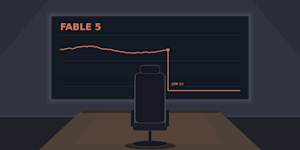
Two-thirds of enterprises have hedged their AI model strategy, and the past few weeks of controversy around Anthropic’s Claude Fable 5 model showed why that posture has gone mainstream. On June 12, a U.S. export-control order pulled Anthropic's Claude Fable 5 — the most capable model on the market — offline for every customer, with no warning and no timeline. It returned this week wrapped in tighter safeguards, after China's Z.ai released its open-weights GLM-5.2 into the vacuum. New VentureBeat Pulse Research, which surveyed 145 enterprises across these last few weeks, shows that two-thirds had already hedged their model strategy before the order came down: 51% blend closed frontier models with open-weight models deployed on their own infrastructure, and another 16% are moving core workflows off closed APIs entirely. The remaining third was all-in on closed ecosystems when the lights went out. The blackout put a spotlight on vendor dependency, by showing what happens when the model you rely on disappears. But vendor dependency is only the most visible piece of a deeper problem: Most enterprises lack the monitoring to know when an AI system they've put into production stops working correctly. Just 1 in 10 enterprises has automated monitoring that would catch an AI model drifting, misbehaving, or failing in production. Roughly a quarter would learn of a production failure only when end users — internal or external — report it, or lack the visibility to detect it at all. And 79% of enterprise organizations have already taken a real financial or operational hit from autonomous agents — most often shadow AI, unauthorized agentic work run by enterprises' own employees on corporate credit cards, outside anyone's oversight. We call this the “Control Gap,” or the distance between how aggressively enterprises are deploying AI and how little of it they can see, own, or govern. June’s blackout turned this into a live stress test. About this data: VentureBeat Pulse Research surveyed 145 qualified respondents at organizations with 100 or more employees in June 2026, with fielding spanning the Fable 5 blackout that began June 12. The sample is self-selected and directional: 41% work in technology/software, 20% are consultants or advisors, and the respondent base skews senior and technical — CIO/CTO/CISOs (18%), directors of engineering/IT (14%), enterprise architects (12%). More than half of the respondents were from companies with 10,000 employees or more. While our sample is not huge, what you can trust more than the exact percentages is the pattern: Every question in the survey, independently, points the same way, with deployment running ahead of governance, visibility, and cost control. The full methodology is in the report. How the Fable 5 export order rewrote enterprise AI risk Fable 5 launched June 9 to immediate acclaim — and sticker shock, at $10 per million input tokens and $50 per million output. Three days later, the U.S. government issued an emergency export-control directive barring access by foreign nationals. Anthropic, with no way to verify nationality in real time, suspended the model for everyone. Z.ai has continued to pick up momentum; on Wednesday it released an open agentic coding environment, called Zcode. OpenAI, meanwhile, previewed its cutting-edge GPT-5.6 line on June 26. Enterprises had already spent the spring learning what AI dependence costs in dollars. Uber burned through its entire 2026 AI coding budget in four months after Claude Code adoption hit 84% of its roughly 5,000 engineers, Forbes reported. Microsoft canceled most internal Claude Code licenses in its Windows and Microsoft 365 division, steering engineers to its own tooling, according to The Verge. June added the harder lesson: The model your workflows depend on can vanish overnight, by government order, through no decision of yours or your vendor's. And Chinese companies like DeepSeek were releasing hugely disruptive, powerful models, driving down costs to a fraction of Western ones. Brian Craig, senior director of architecture at Liberty IT, the Ireland-based engineering arm of Liberty Mutual, one of the world’s largest insurance companies, saw both lessons collide in real time. Craig is Irish, which meant the export order hit him directly as a foreign-national user. Onstage at VentureBeat's AI Impact event in New York on June 24, mid-blackout, I asked him about it. "Fable arrived, and immediately you saw the sticker price of using it, and you went, 'Ooh, goodness, it better be really good,'" Craig said. "But luckily enough, we didn’t get to use it enough to get to fall in love with it." Then it was gone. The hedge was already built before the blackout hit Craig's company was built to route around exactly this kind of disruption. Liberty IT runs what it calls an AI backbone — roughly 50 components spanning security, governance, observability, and orchestration, each independently replaceable. "You can't lock in right