Breathe Pakistan: International Renewable Energy Agency official calls for investing in solar infrastructure
AI Summary
The Breathe Pakistan conference featured discussions on the importance of investing in renewable energy infrastructures, notably solar power, to address climate vulnerabilities faced by Pakistan. Experts highlighted the necessity for innovative financing and policies to facilitate this transition to a more sustainable energy approach.
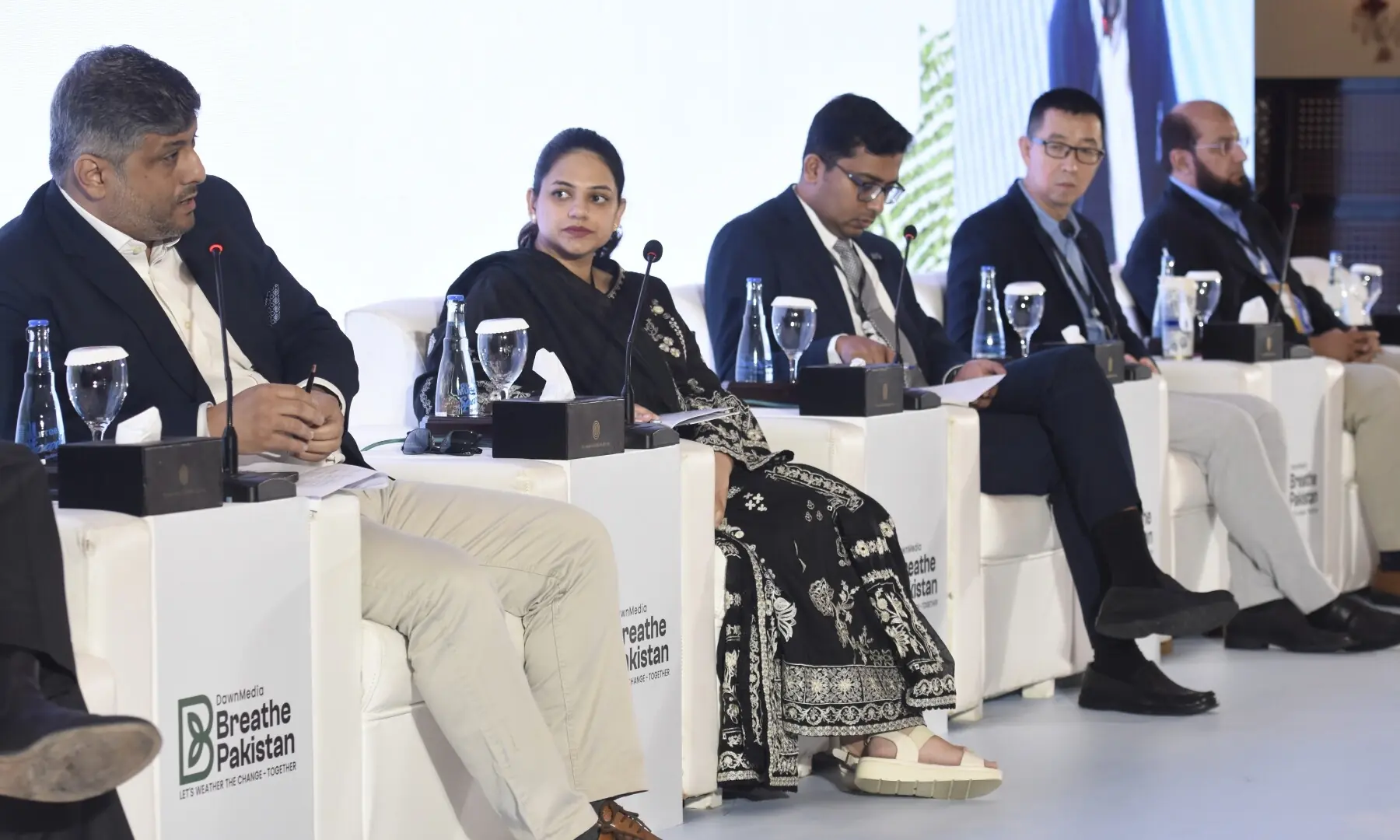
The second day of the second edition of the Breathe Pakistan International Climate Change Conference, organised by DawnMedia, is currently underway in Islamabad. Despite contributing minimally to global emissions, Pakistan remains among the most climate-vulnerable nations, underscoring the critical need for coordinated, locally grounded, and globally informed responses. The two-day conference is bringing together policymakers, experts, and stakeholders from across sectors to examine intersecting challenges and chart a path forward. On the first day, federal ministers, government officials, business leaders, and agriculture and water experts were among the various speakers who presented their perspectives on tackling the climate crisis. View the full agenda here. 2:30pm — Panel talk begins on climate action and private sector A panel talk part of the conference’s 10th session, titled “Why climate action should make business sense?”, has begun. Nadia Rehman, member of the Board of Trustees of SBP’s Climate Risk Fund, is moderating the discussion. 1:40pm — Lunch break 1:35pm — Solar boom ‘not surprising, but rational’ Panelists at session titled “Empowering Pakistan’s Transition to Clean Energy”. — White Star/ Tanveer Shahzad A representative from the Global Renewable Congress, Ali Gülcegün, addressed the conference in a video message and said that Pakistan’s solar boom was not “surprising, but rational”. He said that Pakistan’s official electricity registry showed “30,000 net meter solar installations”. However, he added that the “reality was different”. Gülcegün added, “The vast majority of connections are unregistered,” pointing out that Pakistan’s energy planning “has been working with the wrong numbers”. He further stated that Pakistan’s solar transition happened as a result of “the grid failing to deliver what people needed as well as soaring prices”. With load shedding in temperatures of 45°C and reduced solar panel cost, the official said that “with these factors combined, the consumer decision was rational”. 1:28pm — ‘Many factors’, not financing catalysed Pakistan’s energy revolution: expert Lums Energy Institute Director Dr Naveed Arshad, speaks at Breathe Pakistan. — White Star/ Tanveer Shahzad Lums Energy Institute Director Dr Naveed Arshad, speaking about Pakistan’s energy revolution, said, “We have not used probably a single dollar of climate financing in all this transition. There were many factors combined together.” He noted that Pakistan witnessed “a very interesting revolution of the grid that we have not seen in any country”, adding that the transition was from a connected grid to a distributed grid. 1:21pm — Expert notes need for good policies, very smart financing mechanisms People of Asia for Climate Solutions Founder Tom Xiaojun Wang speaks at Breathe Pakistan. — White Star/ Tanveer Shahzad People of Asia for Climate Solutions Founder Tom Xiaojun Wang noted that Pakistan and China have reacted to the fossil fuel prices differently. “When we talk about energy anxiety, this is exactly where” new and already existing technology can be used, he said, mentioning the recent energy crisis resulting from the oil crisis. “We are not really in shortage of technology, we are not really in shortage of even financing in many ways […] What we need to do is mobilise very good policies and very smart financing mechanisms,” Tom emphasised. 1:12pm — IRENA official calls for investment in solar infrastructure Kamran Siddiqui speaks at Breathe Pakistan. — White Star/ Tanveer Shahzad Kamran Siddiqui, programme officer for energy and infrastructure at International Renewable Energy Agency (IRENA), speaking about Pakistan’s solar transition, said there was a “need for investment at the infrastructure level, particularly at the grid side”. “We need to decide how the energy is going to be deployed, whether it’s behind the meter or net-metering.” He also noted an increase in the import of solar batteries “over the past three years”. However, he added that the solar boom had also “created challenges for the government as the demand for grid supply has reduced”. 1:05pm — ‘Consistent decline in fossil fuel consumption over last 3-4 years’ Haneea Isaad speaks at Breathe Pakistan. — White Star/ Tanveer Shahzad Haneea Isaad, energy finance specialist at Institute for Energy Economics and Financial Analysis (IEEFA), noted that Pakistan was managing the ongoing situation resulting from the Middle East war relatively well, with no fuel shortages. “Over the past three to four years, we have seen a consistent decline in fossil fuel consumption, whether its oil, gas or coal,” Isaad pointed out. She highlighted Pakistan’s “rapid solarisation drive”, adding that the shift took place in 2022 after the Russia-Ukraine war broke out. 12:57pm — Panel talk on clean energy begins A panel talk, titled “Empowering Pakistan’s Transition to Clean Energy”, is no