After two crisis-ridden years, Pakistan’s UN envoy heads home to take up foreign secretary mantle
AI Summary
Pakistan’s outgoing UN ambassador, Asim Iftikhar Ahmad, is returning from New York to become the country’s foreign secretary after a two-year assignment. His tenure included Pakistan’s Security Council role during the May 2025 military confrontation with India and advocacy for peaceful dispute settlement and reform of the council.
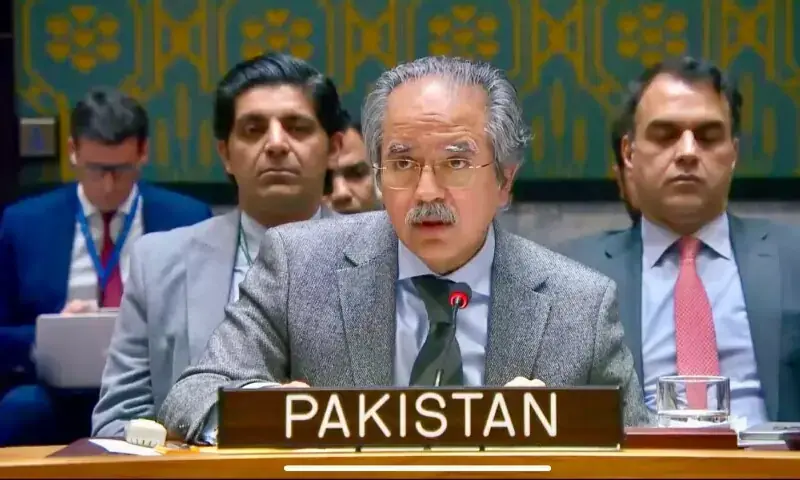
UNITED NATIONS: Ambassador Asim Iftikhar Ahmad leaves New York this week to take up his new responsibilities as Pakistan’s foreign secretary, ending his two-year assignment as the country’s permanent representative to the United Nations (UN). He arrived in New York in October 2024 for his third assignment at the United Nations, as Pakistan prepared to begin a two-year elected term on the UN Security Council (UNSC). It was his third consecutive term as part of Pakistan’s UNSC teams, following assignments in 2003-04 and 2012-13. “It is such a great and singular honour to have the opportunity to represent Pakistan at the UN, including at the Security Council,” Ahmad said in an interview with Dawn. His tenure unfolded amid an extraordinary succession of crises: last year’s brief military confrontation between India and Pakistan, the continuing catastrophe in Gaza, the war between Israel and Iran and growing divisions within the international system. Pakistan brought “a lot of expertise and institutional experience” to its eighth term on the UNSC, Ahmad said. Its priorities were focused on international peace and security, including conflict prevention and peaceful settlement of disputes, peacekeeping, counter-terrorism and cooperation with regional organisations, he added. Within months of his arrival, relations between Pakistan and India deteriorated sharply, leading to a four-day military confrontation in May 2025 that brought the two nuclear-armed neighbours dangerously close to a wider conflict. The UN repeatedly urged both sides to step back from the brink and offered its good offices to help de-escalate the crisis. Ahmad kept UNSC members and other UN delegations informed of Pakistan’s position and the dangers of further escalation. Pakistan and India agreed to a ceasefire on May 10. For Ahmad, the confrontation was particularly significant because Pakistan itself was serving on the UNSC. In assessing Pakistan’s subsequent emphasis on peaceful settlement, he pointed to the May 2025 conflict, saying Pakistan had initiated and steered a UNSC resolution after “having inflicted a crushing defeat to the Indian aggression in May 2025.” One of the principal results he cited was UNSC Resolution 2788, adopted unanimously during Pakistan’s presidency in July 2025. The Pakistan-sponsored resolution called for greater use of the mechanisms provided by the UN Charter for the peaceful settlement of disputes. Ahmad described it as a landmark resolution, saying it had been “the most widely referred UNSC decision” since its adoption, something he said testified to its importance and relevance to the council’s work. Despite the geopolitical tensions reflected in a polarised council, he said, Pakistan had been able to forge consensus around the resolution. He also used his assessment of Pakistan’s tenure to argue for reform of the UNSC. Ahmad said developments in the international peace and security landscape, together with growing criticism of the role of the permanent members, had reinforced the belief of a wide majority of UN member states that the council needed to become “more democratic, representative and accountable”. Adding new individual permanent members, he argued, would only aggravate the problem. “In simple words, the problem cannot be the solution,” he said. Pakistan, he added, had worked with its partners in the Uniting for Consensus group and other like-minded countries for a reformed council with more elected seats, including medium-term seats based on periodic elections and rotation. Such an arrangement, he said, would allow for representation and accountability corresponding to the realities of today’s world. “Pakistan and many other countries are eminently qualified to bring their contribution to the UNSC and the maintenance of international peace and security,” Ahmad said. “Member states should be ready to fulfil that responsibility without permanence and privilege,” he said. Gaza became another defining issue of his tenure. Pakistan repeatedly raised the Palestinian question at the UNSC and the General Assembly, calling for an end to the killing and humanitarian suffering and adherence to international law. Ahmad described Pakistan as a “forceful voice” on Palestine. He pointed to Pakistan’s support for the Comprehensive Plan on Gaza and Security Council Resolution 2803, which he said brought about a ceasefire, opened humanitarian space in Gaza and, importantly, restored a political horizon for Palestinian self-determination and statehood. The Israel-Iran war in June 2025 and subsequent direct US strikes on Iranian nuclear facilities presented Pakistan with another delicate diplomatic challenge. Iran is Pakistan’s neighbour, and Ahmad said Pakistan played an important role in mediating between the United States and Iran, bringing about a ceasefire in April, the Islamabad talks and the process that led to the signing of the Islamabad Memorandum of Understanding in June 2026. “Our leadership remains clo