A lopsided equation
AI Summary
The article discusses the impact of climate change on Pakistan, highlighting how international political decisions have shifted focus from climate commitments to military spending, exacerbating the situation in Pakistan, which contributes minimally to global emissions yet faces severe consequences. It points out the urgent need for climate action in light of growing military emissions and the resulting ecological degradation affecting regions like Pakistan.
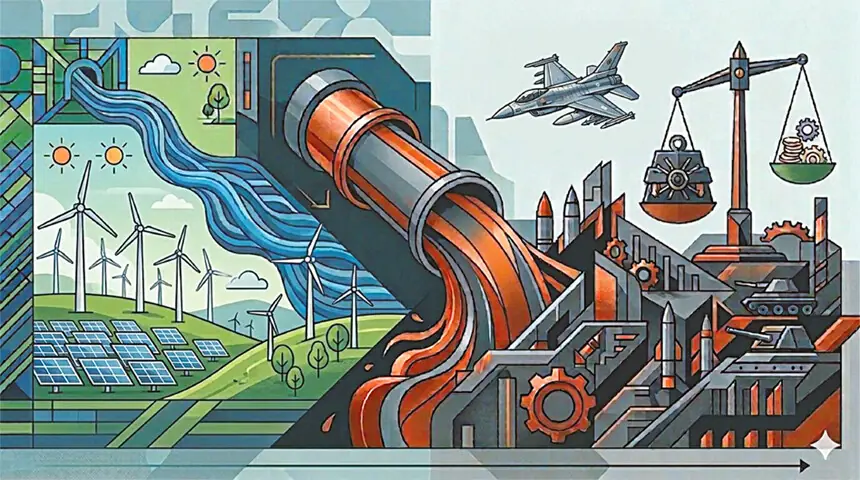
WHILE the United States continues to dismantle the international climate architecture it once helped build, wars from Ukraine to the Middle East are generating unaccounted emissions, consuming the fiscal space that wealthy nations pledged to climate finance, and returning fossil fuels to the centre of global strategy. Meanwhile, 2024 was the first calendar year to go above the 1850-1900 pre-industrial level; the critical 1.5°C threshold. The tipping points have arrived. What climate models warned would happen by 2080 is happening already. At the receiving end stands Pakistan, a country that caused less than 1 per cent of the problem and is living with an outsized share of the consequences. Its glaciers are melting. Its monsoon no longer arrives on schedule, bringing, instead, either punishing drought or catastrophic flood. Its rivers are caught between a warming mountain range above, and hostile neighbours below. This is not a collection of separate crises. It is one crisis, with many faces, bearing down on us. And time is running out. In January this year, the United States withdrew from the United Nations Framework Convention on Climate Change, the foundational 1992 treaty ratified by the Senate by a vote of 92-0 and upheld by every administration since. It simultaneously withdrew from the Paris Agreement, the IPCC, and the Green Climate Fund. No country had ever done this before. The decision was taken in a world already destabilised by the wars in Ukraine and Gaza, by a Nato rearmament that has absorbed the fiscal space European governments once directed at climate finance, and by a Gulf energy crisis that has returned fossil fuels to the centre of global strategic thinking. The Trump administration’s fossil fuel revival and Europe’s sharp turn towards defence spending reflect the same underlying judgment: that security, defined narrowly, takes precedence over survival defined broadly and over time. Developed countries are choosing to strengthen themselves in the short term at the cost of planetary health and their economies at the cost of the ecosystems that underpin them. Pakistan did not make this judgment, but it is living with its consequences. The diversion from climate finance to military spending has dwarfed commitments made at global forums. Pakistan is getting what it does not deserve, stresses Ali Tauqeer Sheikh The wars generating political realignment are also generating emissions that dwarf the reductions governments have pledged. The Ukraine war has produced an estimated 230 million tonnes of CO2 equivalent over three years. The first 15 months of Israel’s war on Gaza generated at least 31 million tonnes. Global military spending reached a record $2.7 trillion in 2024. Treated as a country, the military sector would rank fourth in the world by emissions, accountable to no climate framework and invisible in every NDC submitted to the UNFCCC. Military emissions remain exempt from Paris Agreement reporting, a loophole never closed. The $300 billion climate finance pledge of COP29 is being dismantled by the same governments that signed it. The UK cut real-terms climate finance by roughly 50pc to fund defence spending. Germany and several other EU countries have made equivalent choices. The US has cut international climate finance to zero, and is actively working to dismantle both its own domestic climate commitments and the global agreements it once helped build. Closer to home, Pakistan’s military standoff with India in May 2025 distracted focus from the regional climate agenda at the precise moment NDC 3.0 implementation needed to be consolidated. The closure of the Strait of Hormuz has exposed how shallow the global energy transition remains beneath its headline numbers. When the Strait closed, the response of major Asian economies was to scramble for alternative fossil fuel supply, reactivate mothballed coal plants, and sign emergency LNG contracts at premium prices. India, Bangladesh, Vietnam and the Philippines increased coal-burn during the crisis. Japan and South Korea extended the operational life of coal and gas plants they had pledged to retire. Across Asia, coal is not a relic of the past. It is the backstop that governments reach for the moment energy security is threatened, and the Hormuz closure was a reminder of how quickly that moment can arrive. The IEA had projected fossil fuel demand peaking before 2030. The Hormuz crisis, arriving on top of the Ukraine war, has put that projection in a serious doubt. For Pakistan, which had begun to reduce its LNG import exposure through grassroots solar revolution, the lesson is both cautionary and instructive: the energy transition is real, but it is fragile, and every geopolitical shock tests whether governments have the institutional resolve to stay the course, or the political instinct to retreat to the fuel they know. The grand ambitions of successive COPs, from the $100 billion promise of Copenhagen to the 1.5°C target of Pari